Start here
Christianity: A Beginner's Guide for the Genuinely Curious
Observation window: 2026-09-25. A plain-language starting point for people who know almost nothing and want to understand — not to be converted.
What this guide is (and isn't)
This guide describes what Christianity is and what its major traditions teach, the way a field guide describes birds. It does not tell you what to believe. Christians themselves disagree on plenty below, and those disagreements are noted rather than settled. Where numbers appear, they are labeled with their source and date.
The short version: Christianity is a religion centered on the belief that Jesus of Nazareth is the Son of God, who died and rose again, and that his life, death, and resurrection are the decisive act of God's relationship with humanity. Roughly 2.3–2.5 billion people identify as Christian — the exact figure depends on who's counting (Pew Research: 2.27 billion in 2020; the Center for the Study of Global Christianity: 2.5 billion in 2020). See the hype audit for why those numbers differ.
Where to start reading the Bible
This is the single most-asked beginner question online. The consensus answer from experienced readers is consistent: start with the Gospel of John, then read Acts, then Romans or Ephesians. The Gospels tell the story of Jesus; everything else in the New Testament explains what his followers thought it meant.
Beginners frequently report starting at page one — Genesis — and getting stuck. As one commenter put it:
"Is it okay if I decided to just start from Genesis and work my way through?" — comment, Instagram, 2025-10-12 (source)
And the honest follow-up from others who tried:
"Numbers was a hard read 😂 a little of Leviticus too" — comment, Instagram, 2025-10-12 (source)
The standard advice, from a Christian forum:
"I would suggest that you start with the Gospel of John. It is a beautiful Gospel." — reply, "Advice for a Baby Christian," christianforums.net
Another commenter's reading order is representative of Gospels-first advice:
"Matthew - Meet Jesus, see His life, teachings, death, and resurrection." — comment, Instagram, 2025-10-12 (source)
Nothing stops you from reading Genesis first. But if you want to understand what Christianity is before tackling ancient genealogies, the Gospels are the on-ramp.
Which translation should I read?
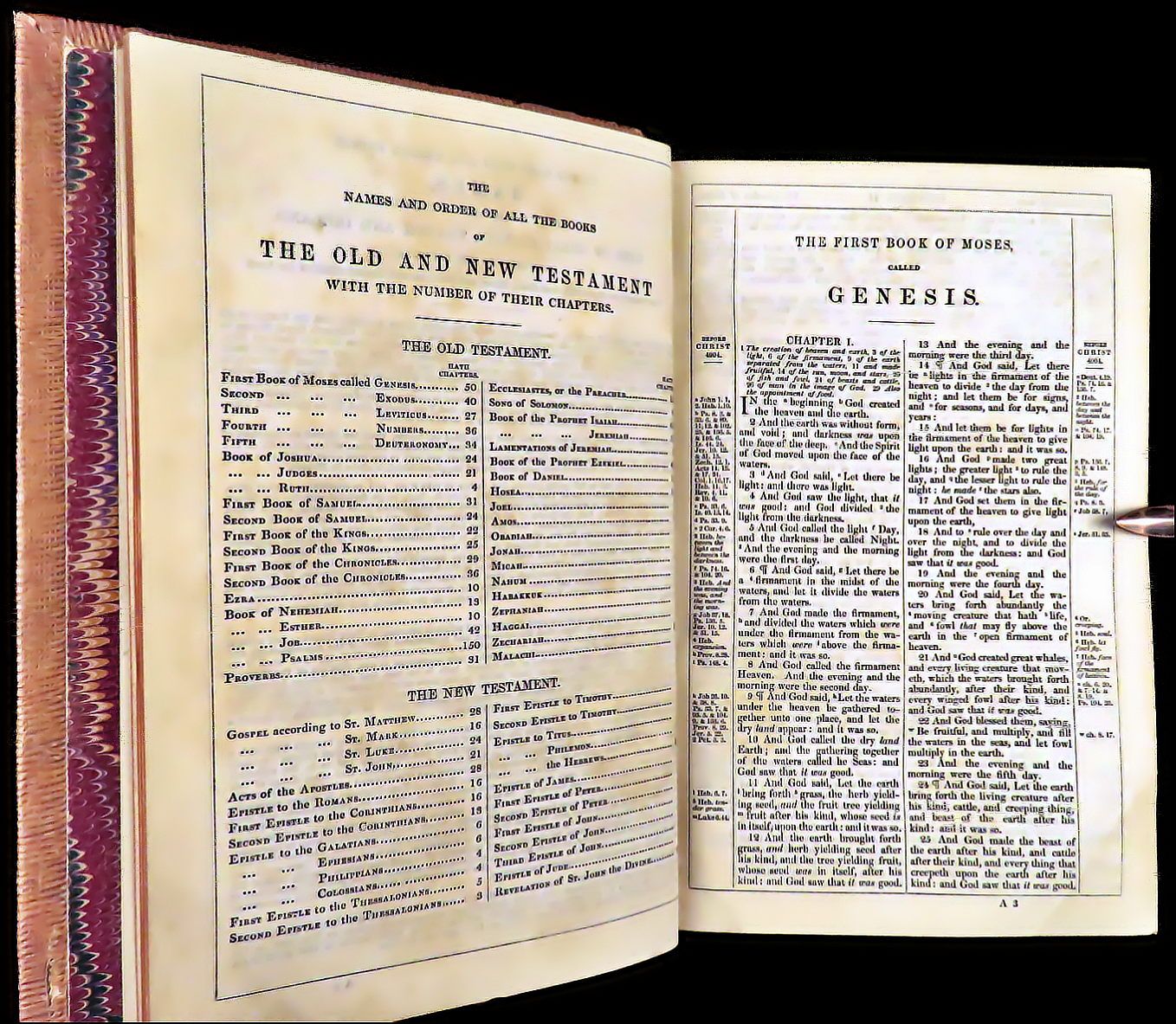
The Bible was written in Hebrew and Greek (a bit of Aramaic), so every English Bible is a translation — and translation choices are the single most argued-about topic in English-language Christian discussion. The main options you'll hear about:
- KJV (King James Version, 1611) — the historic standard, famous for its language ("thee," "thou," "shall"). Some readers love it; many beginners find it hard to understand.
- NIV (New International Version) — a widely used modern translation in plain English.
- ESV (English Standard Version) — a modern translation that stays closer to word-for-word.
- NLT (New Living Translation) — a modern translation that favors readability and thought-for-thought rendering.
Two facts that clear up most of the argument:
- Translations differ partly because they use different ancient manuscripts. The KJV was translated from a manuscript family called the Textus Receptus; most modern translations use older manuscripts discovered later. Some verses familiar from the KJV (for example, Matthew 17:21) don't appear in some modern translations — not because of a conspiracy, but because those manuscripts don't contain them. This is a real, technical disagreement, not a hoax — but it's also not a cover-up. See the hype audit.
- The "missing verses" debate is the single most divisive recurring argument. You'll see claims like "NIV leaves out the later verses" (Instagram, 2026-08-07) and "no words in the bible are supposed to be changed" (Facebook, 2026-02-26). Others push back: "Best translation is the one you read consistently" (Instagram, 2026-08-07), and "KJV I couldn't read or understand I went with NIV and listen it was a game changer" (Instagram, 2026-07-23).
Practical advice for a beginner: pick a modern translation you can actually read (NIV, ESV, or NLT), and get a study Bible with explanatory notes — "ESV study Bible is my jam" (Instagram, 2026-06-23). Don't let the translation wars stop you from starting; as one exasperated commenter wrote:
"People be so caught up on which translation to read Instead of Just reading his WORD" — comment, Instagram, 2026-07-23 (source)
Catholic, Protestant, and Orthodox — the quick orientation
Christianity's biggest internal division is between three families:
- Catholic (~1.406 billion, Vatican 2023 data) — the largest single body, led by the pope; authority rests in Scripture, Tradition, and the Church's teaching office. Worship centers on the Mass.
- Eastern Orthodox (~290 million including Oriental Orthodox, CSGC 2020 data) — authority in councils, Scripture, and Holy Tradition; no pope; worship centers on the Divine Liturgy with icons and chant.
- Protestant (~580 million plus ~390 million Independents, CSGC 2020 data) — a family born of the 16th-century Reformation; Scripture is the supreme authority; huge internal variety (Lutheran, Baptist, Methodist, Pentecostal, non-denominational, and more).
See denominations-compared.md for the full descriptive comparison, including the Oriental Orthodox family (Coptic, Armenian, Ethiopian, and others — a distinct tradition many newcomers have never heard of).
What do Christians say you have to believe?
Formulaic answers circulate widely, and traditions genuinely differ:
- Many evangelicals teach a three-step framework often summarized as "admit, believe, confess" — admit you're a sinner, believe Jesus died and rose, confess him as Lord. One commenter's version: "Believing on the Lord Jesus Christ and thou shalt be saved" (Facebook, 2026-08-03).
- Some traditions emphasize repentance and baptism; one forum reply laid out a Restorationist formula: "1. Belief and faith 2. Confession of your belief 3. Repentance 4. Baptism for the remission of sins" (christianforums.net).
- Catholics teach that salvation comes by grace through faith, expressed in the sacraments and works of charity — and push back hard on the claim that they teach "works = salvation." (See debates-mapped.md.)
- A newcomer's honest self-description: "I am a sinner trying to learn more about God" (Instagram, 2026-08-28). "I am new to Christianity, I was brought up in an Atheist household so never learnt about any religion. What advice would you give?" (christianforums.net)
You will find confident, contradictory answers to "what must I believe." That's not a flaw in your research — it's the reality of a 2,000-year-old religion with 44,900+ denominations (CSGC, 2024 table).
Finding a church
Practical steps people commonly take: visit several churches, observe a full service, ask about their statement of faith, talk to members about what newcomers experience. Note that "finding a good church" and its mirror — "church hurt" and leaving-church stories — are a large, emotionally charged genre online. Some people leave and return; some don't. Both experiences are common enough to be worth knowing about before you start.
Key terms you'll meet
A few to get you started; the full list is in the jargon decoder:
- Gospel — literally "good news"; also the name for the four books about Jesus (Matthew, Mark, Luke, John).
- Grace — God's favor given freely, not earned; central to nearly every tradition's account of salvation.
- Trinity — the teaching that God is one being in three persons (Father, Son, Holy Spirit); famously hard to explain, which is why so many analogies circulate.
- Denomination — an organized Christian body with its own governance and (usually) theology, like Baptists or Methodists.
- Liturgy — a structured, traditional order of worship.
- Evangelical — a broad movement emphasizing the Bible's authority, personal conversion, and sharing the faith.
Limitations
- Community evidence is English-language and comes from public Instagram/Facebook reels and forums; Facebook Groups were inaccessible and TikTok/YouTube comments were only available via snippets. Non-English Christianity (Latin America, Africa, Asia) is a blind spot.
- All figures are labeled by source; Pew and CSGC global totals conflict (see hype audit).
- This guide describes what traditions teach; it does not adjudicate which is true.
Source notes
- Pew Research Center, "How the Global Religious Landscape Changed from 2010 to 2020" (published June 2025, 2020 data), via TBS News summary, 2025-06-11: 2.27B Christians, 28.8%.
- CSGC "Status of Global Christianity 2024" table (via thetravelingteam.org PDF mirror): 2.5B (2020); 44,900 denominations.
- Vatican Annuario Pontificio 2025 (2023 data), via ACI Africa, 2025-03-27 and EWTN, 2025-03-21: 1.406B Catholics.
- Community quotes: verbatim from public Instagram/Facebook reel comments and christianforums.net threads (2025–2026).
- Image:
images/bible.jpg— historic 1873 KJV printing; Wikimedia Commons, public domain.